HOME PAGEFAQ'sOUR PROGRAMSCLASS SCHEDULE
INSTRUCTORS & STAFFCONTACT USNEWS & ARTICLESPICTURES
Black Belt Family TreeNinjutsu/Budo TaijutsuIaidoKobudo
TaekwondoHow do I get started?Members Only

2505 North Tracy Blvd.
Tracy, CA.  95376
209-830-9772
info@traditional-dojo.com


 Frequently asked questions

How do I choose a martial arts school for me or my child?
The principles of choosing a martial arts school are the same for you and your child. The following answer is addressed to parents, as there are a couple of special considerations when children are involved. Step one in choosing a school is to understand clearly what you want you or your child to gain from learning the martial arts. Is it a light recreation? Then a community center program may suffice. Is it self-defense or personal development? If so, then a full-time professional school may be more suitable. Many parents view the martial arts as part of their child's educational development. With a good professional school, this is very possible.
Step two is to recognize that choosing a school really means choosing an instructor. Be sure to visit the school and watch the instructor work with other children of the same age. Every school is very different because every instructor is different. Don't get confused by claims of black belt degrees, tournament wins, or martial arts styles. The only style that matters is the teaching style of the instructor and how you or your child will respond to him or her.
Finally, trust your instincts. A professional school will have a family atmosphere, show lots of smiles, and be well kept. You'll feel comfortable with the personnel and the facility.
While this may not end up being the closest school to your house, when it comes to your safety, or the safety and education of your child, an extra ten minute drive can make a world of difference in the outcome.

How early should a parent start a child in the martial arts?
While martial arts study is an enjoyable and very worthwhile activity for children, it should be recognized that progress will take consistent class attendance, practice at home, and support from the family (kids can't drive themselves to class).
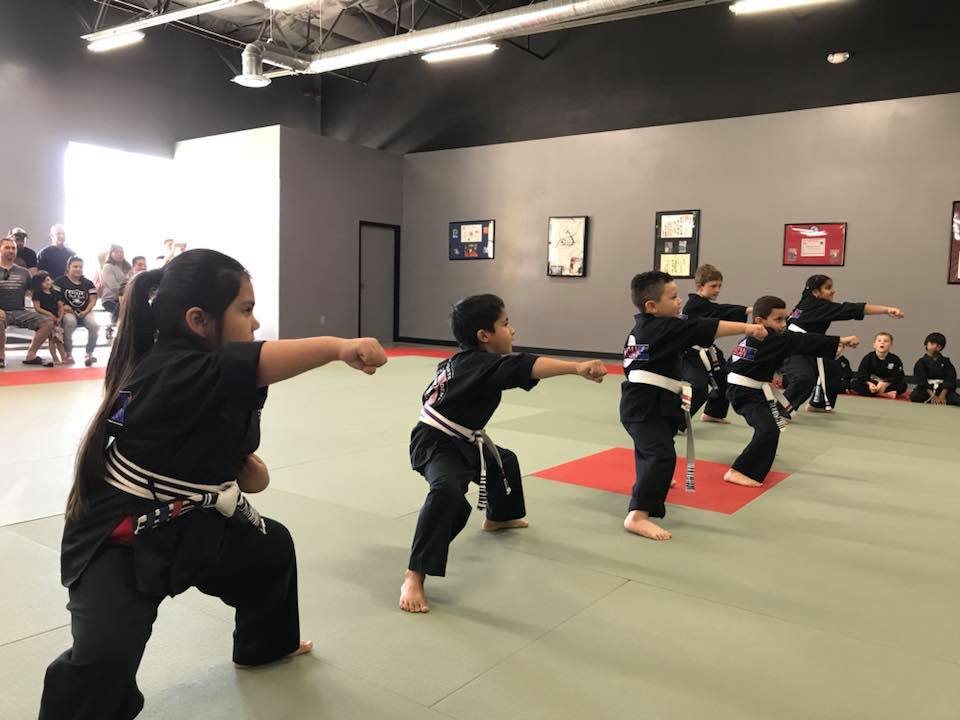
How early to start a child really depends on the individual child and his or her level of interest and maturity. Our school has age-specific classes and curriculum for children as young as 3 1/2 years old. These programs can be a great way for a child to learn concentration, acquire self-control, and start to develop more coordination.

At what age is someone too old to start martial arts training? A person is never to old to start training in the martial arts. The average age of our adult class students is 45 years old, and we have students who are in their mid 60's who are enjoying the benefits of martial arts training as much as anyone.

What are the benefits of martial arts training for children?
Our parents report these five important benefits for their children in our martial arts school.
1. The belt system improves children's self-esteem. The martial arts are not like team sports, because the emphasis is on developing the individual's self-esteem not the team's winning record. The belt system is the key. When kids earn their belts, it gives them a great sens of accomplishment that really improves the way they feel about themselves.      2. Martial arts teach children discipline. One of the things parents appreciate most about the martial arts is the improvement in their child's self-discipline. We have a great staff of patient instructors who love to work with children, but who are also very clear about respecting limits.
3. Martial arts channel children's aggression. Many doctors actually prescribe martial arts for treatment because of the positive outlet it gives kids for all their energy.
4. Martial arts classes enhance children's self-confidence. Confidence is one of the most important things the martial arts can give kids. Our school has confidence-building drills included in each class.
5. Martial arts teach children essential self-defense skills. Our school teaches practical, proven self-defense methods. Our staff is also careful to teach the kids that the techniques they learn in class will work, so they don't go home and try them on a sibling or neighbor. This will be addressed in the very first lesson!

What can an adult get out of the martial arts?
Adult students really appreciate the differences between martial arts training and standard exercise programs.
1. Martial art workouts are a great way to get in shape. The martial arts are like an exercise program with a purpose: you learn to defend yourself while you get in shape.
2. Martial arts relieve stress. The martial arts are well-known for their stress relieving benefits. The emphasis on mind-body training goes far beyond the benefits of standard, health-club - type exercise programs.
3. Martial arts practice sessions provide self-confidence. The confidence-building aspect of martial arts is what students appreciate the most. Nothing can take the place of the security in knowing that you can defend yourself or your family if you have to.
4. What the martial arts teach you could save your life. Our staff of licensed instructors work very hard to ensure that almost any dangerous situation you might encounter is covered in the classroom under very safe learning conditions, so you will be prepared.
5. Martial arts are a lot of fun. The reason the martial arts are so popular is because the class are fun and exciting.

Are all black belts the same?
Unfortunately, no. The requirements for a black belt very widely, and this is true the world over, not just in the United States. In some schools, a person can earn a first degree black belt in just a year or two. Other schools require six to ten years or more of intense training.
If you are thinking, "Gee, I want to train in one of those schools where I can earn a black belt in a couple of years," just remember that it means your instructors won't have much experience either.
The middle road is probably the best path to take. Three to four years of continual practice under a good teacher should provide you with the knowledge and skill to call yourself a black belt.

What belt rank should my instructor be?
In most styles of martial arts, there are ten degrees of black belt, with a new black belt being a first-degree. The problem is that with a lack of standardization in the martial arts, what defines a fifth-degree black belt or a seventh degree black belt varies so drastically that the rank doesn't really convey meaning to the general public. Beyond earning a black belt, rank has little, if anything, to do with quality of instruction.
This is a critical point to understand. just because someone has received a high rank within an art doesn't make that person a good teacher. Indeed, sometimes the opposite is true. Some black belts are more focused on their own achievements or how many trophies and medals they have won or how many champions they have produced rather than the students' real progress as a martial artist and person.
It is very hard to say what rank beyond black belt a professional martial artist should be. But obviously, a school owner or chief instructor should be a black belt or equivalent, depending on the art. Also, if your goal is to earn a black belt and beyond, then you have to have an instructor who is at least a grade or two above where you need to test to become. A 4th-degree black belt cannot promote someone else to 4th-degree black belt. In all systems you have to be one or two degrees higher to promote someone. For instance, an instructor would have to be a third-or forth-degree to promote someone to second degree black belt.
Don't be misled by claims of the title "Master" or "Grandmaster" or tenth-degree black belt. those are not as important as finding an instructor who cares about the students and makes them the focus, instead of seeking all the attention him- or herself. 

How do I know an instructor's credentials are legitimate?
Black belt certificates are a lot like college degree. Some are received after years of hard work, some are received through accelerated programs, some are from correspondence schools requiring little or no study, some are honorary, and some are just plain fraudulent coming from made up styles and masters who cannot be traced or have no true lineage.
The average time it takes to earn a first-degree black belt is three to six years. After that most promotions come in two to six year increments depending on the rank, someone testing from fourth-degree to fifth-degree will wait longer than someone testing from first-degree to second-degree black belt. So the years of experience an instructor has invested in an art are an important factor in determining whether his or her rank is justified. In all reputable martial arts organizations there is also a minimum age requirement for black belts and especially high grade black belts past 4th-degree. You should be suspect of anyone claiming a grade beyond fourth-degree black belt who is under thirty years old for example.
All legitimate instructors will be glad to tell you who they trained under and how to contact them or the organization they're affiliated with. If the instructor will not discuss his or her background or is evasive about certain information, it's safe to assume that the credentials might be questionable or that the instructor is no longer in good standing with his or her teacher. This is never a good sign.
Our schools instructor lineage can be found under the heading "Black belt family tree".

Should I find a "champion" instructor?
The martial arts were never intended to be a sport. They were intended to be used in real conflict, and to learn to master yourself. Titles are not bad things. It's just not an important aspect to look for or be concerned with.
Since just about every martial artist listed in the phone book is a champion of some sort, simply ignore the claims and focus on what they can do for you. 

Do children and adults train together?
No! Not in our school. We have separate classes for children, teens, and adults. The needs of a child differ greatly from that of an adult, especially in the martial arts.


OUR PROGRAMS  

OUR INSTRUCTORS AND STAFF

  THIS PAGE IS UNDER CONSTRUCTION.